Verify Your License Status
If you recently updated your restriction codes and are waiting for your new plastic card to be printed, use our live tracker below to confirm its availability before visiting the LTO branch.
Free · Instant · Relayed live from the official LTO-NCR system, nothing is stored. Type DEMO to preview a sample result.
Understanding the Modern Drivers License Code System
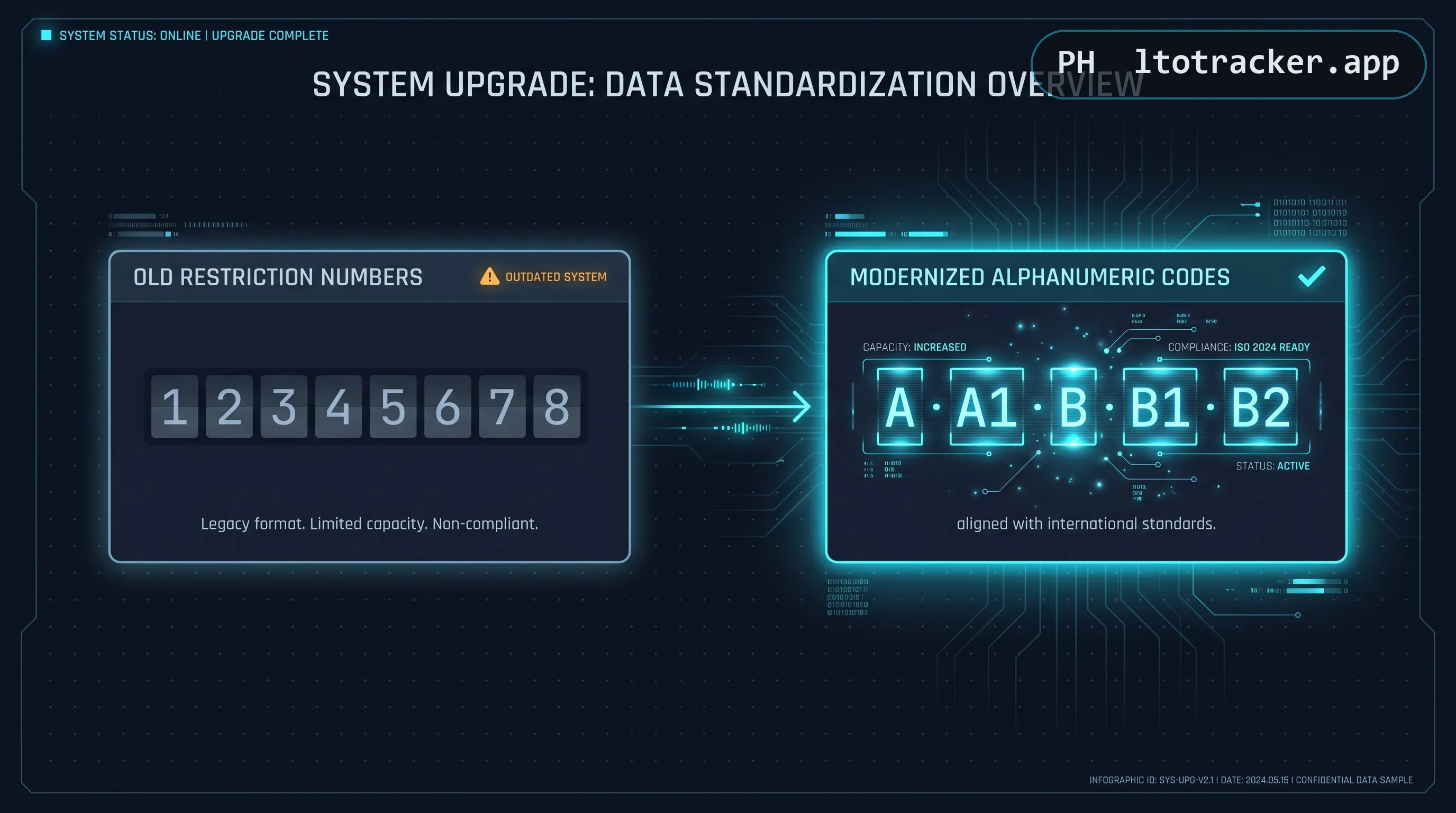
For decades, the Land Transportation Office utilized a simple numerical restriction system ranging from 1 to 8 to classify the types of vehicles a motorist was legally authorized to operate. Restriction 1 was for motorcycles, Restriction 2 for standard passenger cars, and so forth. However, as the automotive industry evolved and the variety of vehicles on Philippine roads multiplied exponentially, this old numerical system proved inadequate. It lacked the granularity necessary to accurately differentiate between highly specialized modern vehicles, leading to confusion among traffic enforcers and motorists alike.
To resolve these critical ambiguities and align the country with international licensing standards, the Land Transportation Office implemented a modernized, alphanumeric drivers license code system. This new framework completely replaced the old single digit restrictions with a more complex but highly specific categorization method using letters and alphanumeric combinations, most notably the a a1 b b1 b2 classifications.
The primary goal of this modernized drivers license code system is to enhance road safety. By creating highly specific categories based on a vehicle gross weight, passenger capacity, and transmission type, the Land Transportation Office ensures that drivers are only permitted to operate vehicles they have explicitly been trained and tested for. Operating a vehicle that falls outside the boundaries of your designated restriction code is treated by law enforcement as driving without a valid license, a severe violation that carries hefty fines and potential vehicle impoundment.
Transitioning to this new system requires every driver to understand their specific authorizations. When you renew your old license, the Land Transportation Office automatically converts your old numerical restrictions into their new alphanumeric equivalents. It is your absolute responsibility to review your newly printed plastic card and understand precisely what the new letters mean for your daily driving habits.
A Deep Dive into DL Code B
Perhaps the most common and widely discussed classification in the new system is dl code b. If you previously held Restriction 2 under the old system, you will notice that your renewed license now prominently features dl code b. This specific classification forms the backbone of private transportation in the Philippines, authorizing the holder to operate the vast majority of standard passenger vehicles found on our roads today.
Specifically, the Land Transportation Office defines dl code b as the authorization to drive passenger cars. This broad definition encompasses sedans, hatchbacks, compact sport utility vehicles, and standard crossovers. The defining technical limitation for this code is weight; the gross vehicle weight of the car must not exceed five thousand kilograms. Additionally, the vehicle is restricted to a maximum passenger capacity of eight individuals, including the driver.
It is crucial to understand the limitations of dl code b. If you attempt to drive a large passenger van configured to carry fifteen people, or a heavy duty pickup truck whose gross vehicle weight exceeds the five thousand kilogram limit, you are operating outside your legal authorization. Even if the vehicle looks like a slightly larger version of a standard car, the technical specifications written on its Certificate of Registration dictate whether your dl code b is sufficient.
Furthermore, your dl code b authorization will be accompanied by a condition code indicating your permitted transmission type. Condition code MT allows you to drive vehicles with manual transmissions, which inherently also grants you the legal right to drive automatic vehicles. Conversely, if your condition code is AT, you are strictly limited to driving automatic vehicles; operating a manual transmission vehicle under an AT condition code is a direct violation of your licensing terms.
Breaking Down the a a1 b b1 b2 Categories

While dl code b covers standard cars, the complete modernization of the drivers license code system introduces several other critical classifications that motorists must comprehend. The most frequently encountered grouping involves the a a1 b b1 b2 categories, which together govern the operation of two wheeled and four wheeled private vehicles.
Category A is dedicated exclusively to motorcycles. If you hold this code, you are authorized to operate standard two wheeled motorcycles regardless of their engine displacement. This covers everything from small capacity underbone commuter bikes to large displacement adventure and sport motorcycles. Similar to cars, your authorization will specify if you are restricted to automatic scooters or permitted to use manual clutch motorcycles.
Category A1 is a distinct subcategory created specifically for three wheeled vehicles. This includes the ubiquitous motorized tricycles, as well as modern symmetrical three wheelers and certain types of quadricycles. The Land Transportation Office created A1 to acknowledge that balancing and steering a three wheeled vehicle requires different mechanical handling skills compared to a standard two wheeled motorcycle. If you only hold Category A, you are technically not authorized to drive a tricycle; you must specifically apply for and be tested for the A1 classification.
As previously discussed, Category B covers standard passenger cars with a gross vehicle weight up to five thousand kilograms and a maximum capacity of eight seats.
Category B1 expands your authorization to larger passenger vehicles. This code allows you to drive passenger vans and specialized transport vehicles that exceed the eight seat limit of Category B, accommodating between nine and fifteen passengers, including the driver. The gross vehicle weight limit remains at five thousand kilograms. If you frequently drive a large family van or a private shuttle, securing the B1 code is a legal necessity.
Category B2 focuses on cargo rather than passengers. This code authorizes you to operate light commercial vehicles and small trucks designed primarily for transporting goods. The critical distinction here is that the vehicle gross weight must remain below five thousand kilograms. This category is essential for individuals operating small delivery fleets, courier vehicles, or utilizing light pickup trucks for personal business logistics.
Understanding the boundaries between the a a1 b b1 b2 classifications ensures that you are always driving within the legal framework established by the Land Transportation Office, protecting yourself from unnecessary fines and severe legal complications in the event of an accident.
How to Add New Restriction Codes
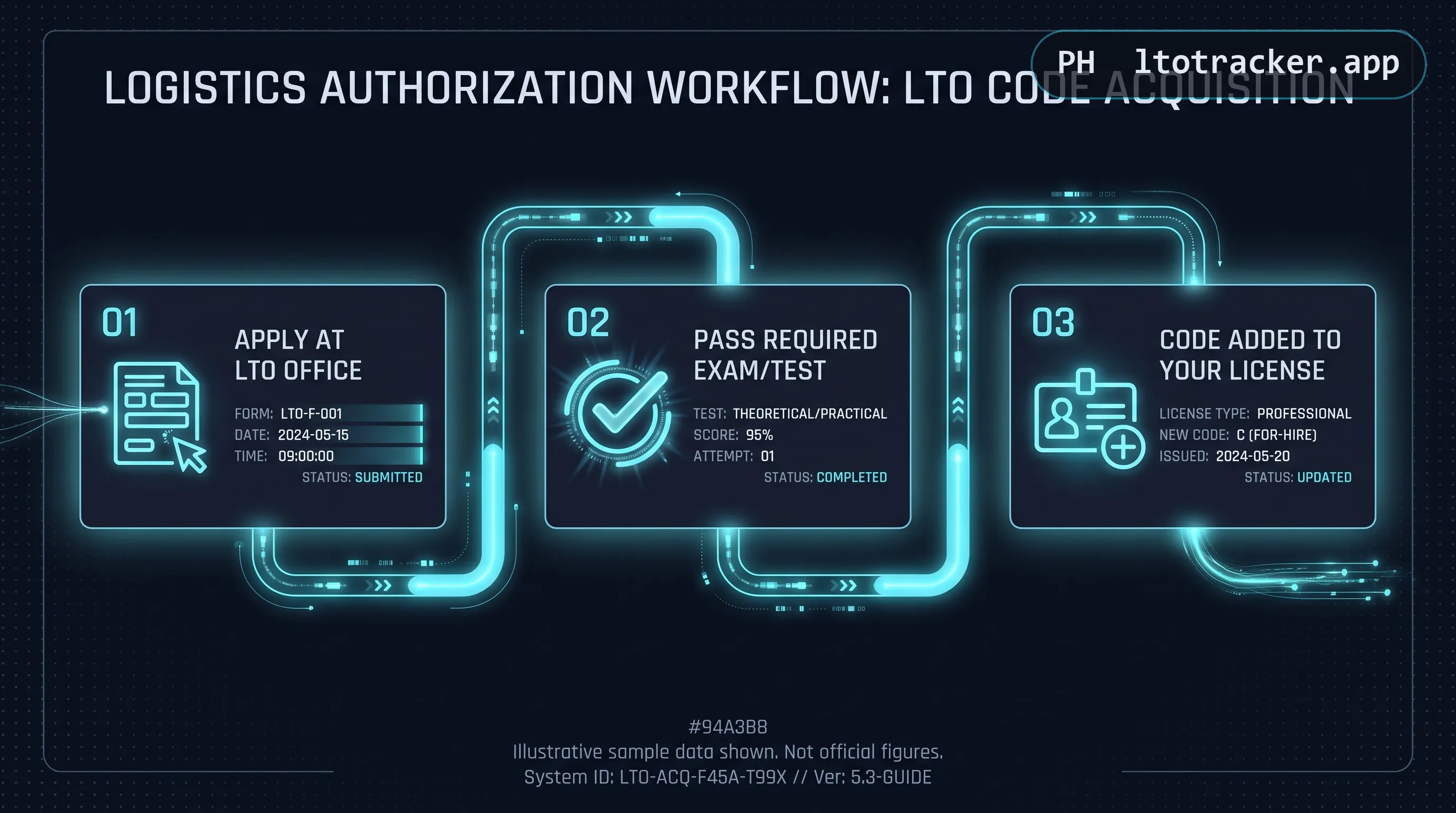
As your driving needs evolve, you may find that your current drivers license code no longer covers the vehicles you need to operate. For example, you may have started riding a motorcycle and need to add Category A, or you purchased a large family van and require Category B1. The Land Transportation Office provides a structured process for updating your license to include new authorizations.
The procedure for adding a new restriction code is remarkably similar to the initial application process for a non professional license. You cannot simply request the addition over the counter; you must prove your competence in operating the new vehicle type. This means you must secure a new Practical Driving Course certificate specifically tailored to the new vehicle category you wish to add.
You will need to enroll in an accredited driving school and complete the required hours of practical instruction for the new vehicle type. Once you receive your new electronic PDC certificate, you must undergo a fresh medical examination at an LTO accredited clinic to verify your physical fitness. Ensure you download and accomplish the Application for Driver License form, clearly ticking the box indicating your intention to add a restriction code.
Proceed to the evaluating window at your preferred LTO licensing center with your current valid license, the new PDC certificate, and the new medical certificate. After the evaluation and payment of the application fees, you will be required to take a practical driving test utilizing the specific type of vehicle corresponding to your requested new drivers license code. If you pass the practical assessment, you will pay the final revision fees, and a new plastic card reflecting your updated authorizations will be printed and released to you.
Penalties for Violating Restriction Codes
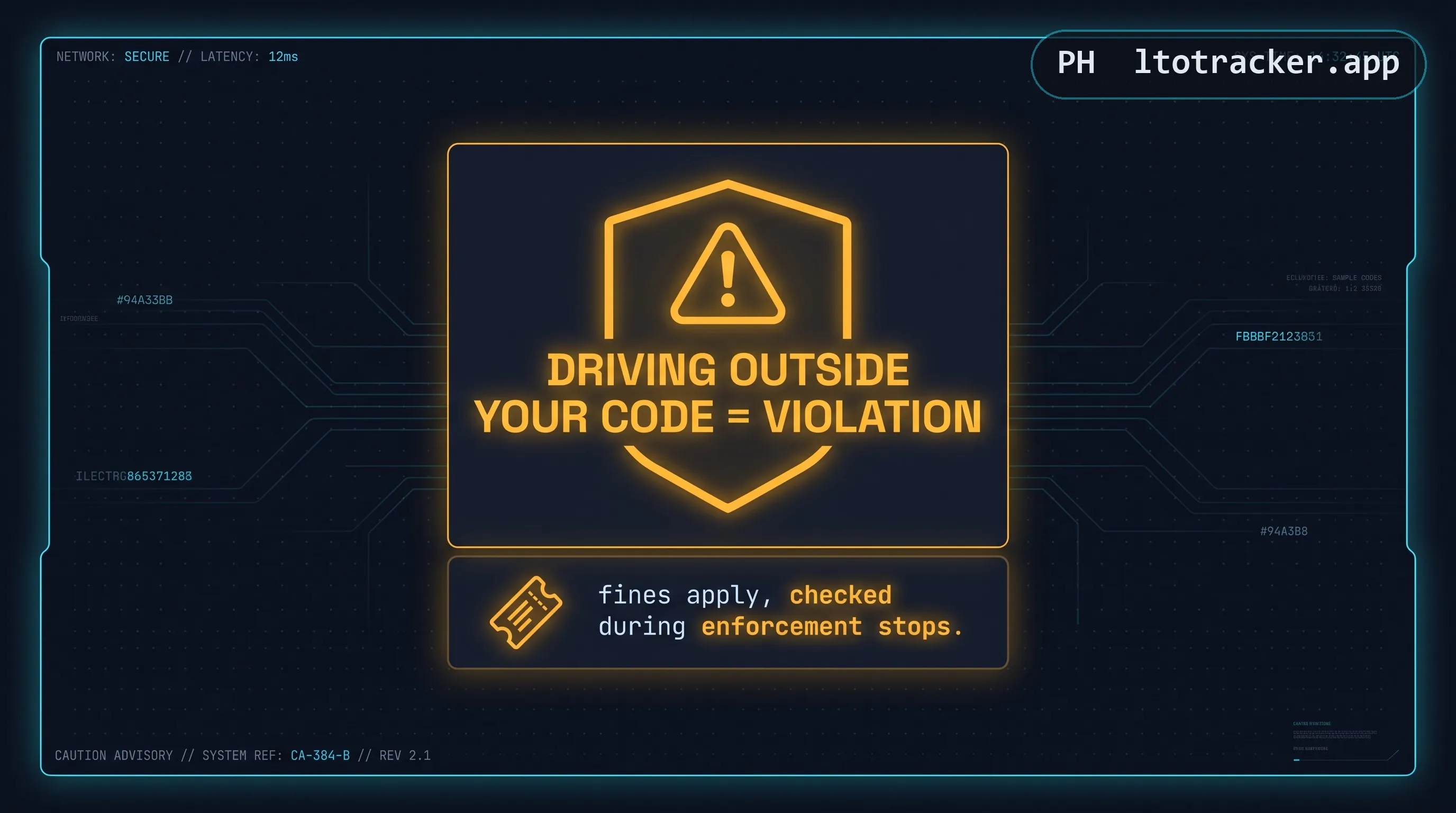
The Land Transportation Office does not treat the drivers license code system as a mere suggestion. These codes are strict legal boundaries, and violating them is treated as a major traffic offense. When a traffic enforcer pulls you over, one of the first things they check is whether your license authorizes you to operate the specific vehicle you are driving.
If you are caught driving a vehicle that falls completely outside your authorized categories, for instance, driving a B1 passenger van when you only hold a dl code b for standard cars, you will be cited for driving without a valid license for that specific vehicle type. The standard penalty involves a substantial monetary fine, which can reach several thousand pesos.
More severely, the traffic enforcer has the legal authority to impound the vehicle immediately, as you are deemed unqualified to drive it safely away from the scene. You will not only have to pay the initial fine but also shoulder the daily impounding fees until a properly licensed driver can retrieve the vehicle. Furthermore, this severe violation will be permanently recorded in your LTO profile. Accumulating such violations will disqualify you from receiving the desirable ten year license validity upon your next renewal, restricting you to the standard five year term and potentially requiring you to attend mandatory retraining seminars.
The financial and administrative consequences of violating your restriction codes far outweigh the inconvenience of undergoing the proper procedure to update your license. Always verify the technical specifications on your vehicle Certificate of Registration and cross reference them with the codes printed on the back of your license card before getting behind the wheel.
The transition to the modernized drivers license code system represents a significant step towards a safer and more organized transportation environment. By thoroughly understanding what dl code b entails, mastering the differences within the a a1 b b1 b2 categories, and adhering strictly to your authorized limitations, you actively contribute to a culture of disciplined and responsible driving in the Philippines.